
How many machines do you need to produce scouring pad?
Starting a sponge‑scrubber factory sounds easy. But you’ll soon find out you can’t make them with just one machine — you need three different machines running one after another.
If you leave anyone out, your line will either stop working, or you’ll have to rely on external suppliers — and that will eat into your profits without you noticing
Making a sponge scrubber requires three machines in sequence:
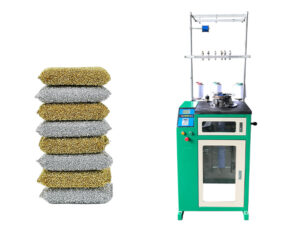
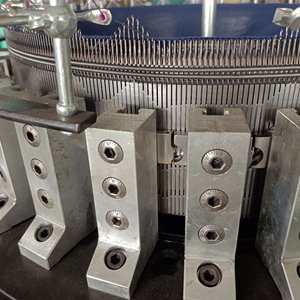
- a knitting machine that turns raw yarn into woven cloth tubes,
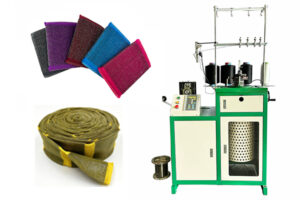
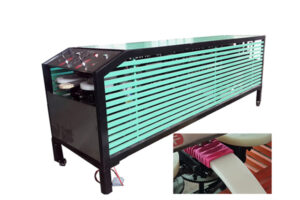
- a fabric-turning and sponge-inserting machine that reverses the tube and inserts the sponge
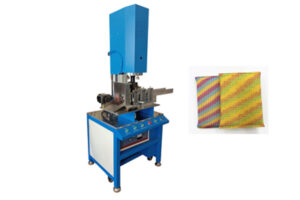
- an ultrasonic welding and cutting machine that seals and cuts each individual scrubber to finished size. Before you spend money setting up your factory, you need to understand what each machine does and how your material choices affect every step.
The three-machine logic sounds simple once you see it written out. But the tricky parts lie in each production step: what yarn mixes makes different scrubbers, which machine model fits your output goals, and whether you really need all three machines right from the start.
Let me walk through each step in detail so you can make that judgment with real numbers in hand.
Step 1: Knitting Machine — How Does Yarn Become Cloth Roll?
A lot of people looking to set up a sponge‑scrubber line overlook this first step. They only think about the final product. But the knitting stage determines what kind of goods you can make, and this step has the most factors that can change your result.
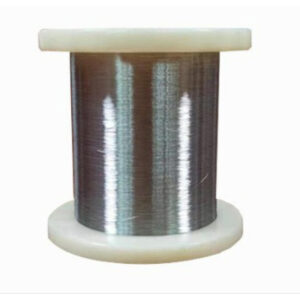
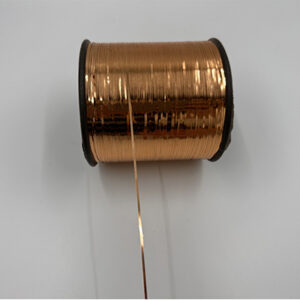
The knitting machine takes raw yarn spools and weaves them into a long cloth tube. The yarn combination you feed into the machine determines whether your finished scrubber will be a standard polyester scrubber, a gold or silver metallic scrubber, or a steel wire scrubber.
These aren’t just small look‑and‑feel differences. They are separate product lines, sold to different markets at different prices.
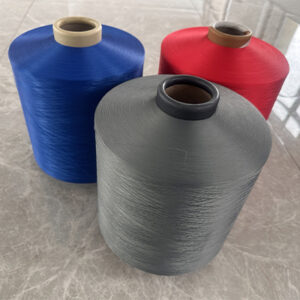
Yarn Combination Determines Product Type
This is the most important mapping any prospective factory owner needs to understand before purchasing equipment. The table below summarizes the three main product paths:
| Yarn Combination | Cloth Type | Finished Scrubber Type | Typical Market |
| 150D 48F polyester yarn only | Soft polyester net cloth | Standard polyester scrubber | Mass retail, household |
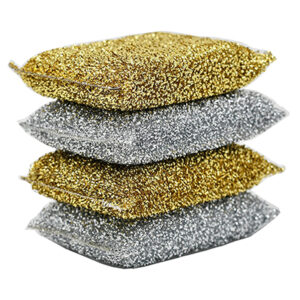
| 150D 48F polyester + M-type metallic yarn | Metallic weave cloth | Gold / silver metallic scrubber | Mid-range retail, export |
| 150D 48F polyester + 0.09mm stainless steel wire | Steel wire reinforced cloth | Steel wire scrubber | Kitchen heavy-duty, |
Note for buyers: The yarn specs above (150D 48F polyester, M‑type metallic yarn, 0.09 mm stainless‑steel wire) are what we use for our machine setups. Check with your yarn supplier to make sure their material grades match before you place large bulk orders.
Machine Model Size and Output Speed
The knitting machine model you select also determines the width of the cloth tube produced, which in turn determines the width of the finished scrubber.
Wider machines make wider scrubbers. That might sound obvious, but this choice is important. You can’t easily modify a machine to make a different tube; tube diameter is a fixed setting for that machine model.
Production speed on our knitting machines runs at approximately 80-120RPM under standard operating conditions. This speed number only applies to our machine models. Don’t use it as the standard for every machine on the market. Actual output depends on:
- Yarn tension consistency — uneven tension reduces speed and increases defect rate
- Operator experience — first-week operators typically run slower while learning tension adjustment
- Yarn quality — lower-grade yarn breaks more frequently, stopping the machine
Can You Buy Pre-Made Cloth Instead of Knitting Your Own?
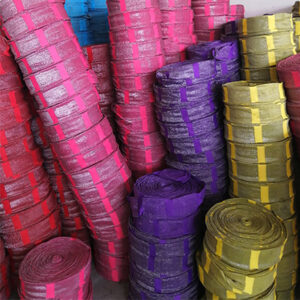
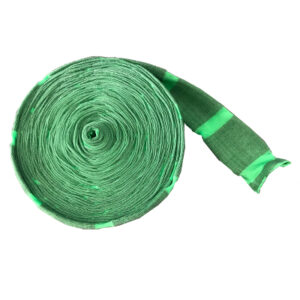
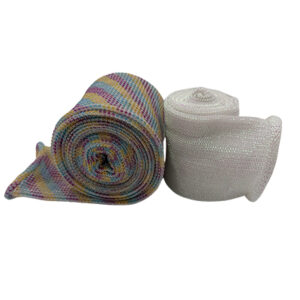
Yes — and this is one of the most common questions we receive from first-time buyers. Purchasing pre-woven cloth rolls from an external supplier and skipping the knitting machine entirely is a legitimate entry path, and for some buyers it is the right one.
Here is the honest trade-off breakdown:
| Factor | Buy Pre-Made Cloth | Own Knitting Machine |
| Upfront capital | Lower — skip machine cost | Higher — full line investment |
| Per-unit material cost | Higher — supplier margin included | Lower — raw yarn is cheaper |
| Product flexibility | Limited to what supplier offers | Full control over yarn mix |
| Supplier dependency | High | None |
| Entry timeline | Faster | Slower (setup + learning curve) |
| Scalability | Capped by supplier capacity | Scales with your machine |
Our recommendation: If your starting production volume isn’t big enough to pay for a knitting machine, you can buy ready‑made cloth to begin with. Run the inserting and sealing machines first to build up your customer base.
Once your weekly output is high enough that you can see real cost savings from buying raw yarn directly, you can add the knitting machine later. The machine does not disappear — you can add it to the line at any point.
Step 2: Fabric-Turning and Sponge-Inserting Machine — How Does the Sponge Get Inside?
Once you have your cloth tube — whether knitted in-house or purchased from a supplier — the next challenge is getting the sponge inside it. Many buyers get confused at this step if they’ve never seen the machine work. The knitted cloth tube comes out inside‑out.
The fabric-turning and sponge-inserting machine does two things in one pass: it flips the cloth tube right-side out, then feeds a pre-cut sponge strip into the center of the tube in a continuous motion. The result is a cloth-covered sponge roll, ready for sealing and cutting.
Sponge Specification Matters Here
The sponge dimensions must be matched to the cloth tube width. If they don’t match — for example, the sponge is too wide or the cloth tube too narrow — the machine will jam, or you’ll end up with deformed scrubbers you cannot sell.
The sponge specification we work with as a standard reference point:
- Width: 8.8 cm
- Thickness: 1.4 cm
These dimensions pair with a specific cloth tube width produced by the corresponding knitting machine model. If you are sourcing cloth externally, verify the tube circumference against this sponge spec before ordering sponge material.
This is one easy‑to‑miss problem if you start by buying ready‑made cloth: your sponge supplier, cloth supplier and machine settings all must work perfectly together.
What Affects Output at This Stage?
- Sponge density and consistency — irregular sponge thickness causes jamming
- Cloth tube tension — too loose and the tube wrinkles around the sponge; too tight and the machine struggles to feed
- Machine speed calibration — needs to match the cutting machine downstream to avoid backlog
Estimating Raw Material per 1,000 Pieces
Factory owners frequently ask how much raw material they need to run a production target. The table below gives a working framework. All figures are approximate and should be verified against your specific machine model and product dimensions before committing them to supplier orders.
Material Estimated Usage per 1,000 Pieces Notes
Woven cloth tube ~35–40 meters (varies by scrubber length) Depends on finished scrubber size
Sponge strip ~35–40 meters Must match cloth tube dimensions
Yarn (if knitting in-house) Varies by yarn weight and tube width Calculate from knitting machine output spec
These numbers are rough estimates only. Make a small test batch first to work out your real material usage per piece before you place big bulk orders.
Step 3: Ultrasonic Welding and Cutting Machine — How Does the Roll Become Individual Scrubbers?
The third machine is where the continuous cloth-covered sponge roll becomes individual, finished sponge scrubbers. This is the step that closes the package — and it is also the step that determines the cleanliness of your finished edge, which directly affects perceived product quality.
The ultrasonic weld‑and‑cut machine uses high‑frequency vibration. It seals both ends of each scrubber and cuts it off from the long roll all at one time. Ultrasonic welding melts and fuses the edges together. No stitches, no glue. That makes the edges stronger and looks much cleaner than other methods.
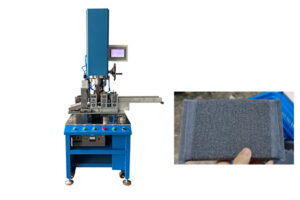
Why Ultrasonic Welding, Not Stitching or Heat Sealing?
This is a question worth answering directly, because buyers comparing supplier quotes sometimes encounter machines that use different sealing methods.
| Sealing Method | Edge Quality | Speed | Durability | Suitable For |
| Ultrasonic welding | Clean, fused edge | Fast | High | Polyester, metallic scrubbers |
| Heat sealing | Acceptable | Medium | Medium | Basic polyester only |
| Stitching | Variable — depends on operator | Slow | Medium | Not standard for scrubbers |
Ultrasonic welding is the standard in current production lines because it works cleanly with synthetic fiber cloth and does not require adhesives, thread, or heat that could degrade the sponge core. For buyers targeting export markets in Europe, this edge quality visibly distinguishes your product from lower-grade competitors.
Scrubber Length is Set at This Machine
The cutting interval programmed into the ultrasonic machine determines the finished scrubber length. This is an adjustable parameter, which means the same machine can produce scrubbers of different lengths — useful if you supply multiple retail customers with different product specifications. You don’t need to swap out any machine parts to change scrubber length. You just adjust the cutting interval setting.
Full Production Line: Cost and Capacity Framework
One of the most practical questions buyers ask before any investment decision is: What does a full three-machine line cost, and what can it produce? I will give you the honest framework for thinking through this, without fabricating specific price figures that depend heavily on configuration, market, and shipping destination.
Capacity Logic
| Machine | Role | Key Output Variable |
| Knitting machine | Produces cloth tube | ~35 m/h (model-dependent — verify before purchasing) |
| Fabric-turning + inserting | Loads sponge into cloth | Calibrated to match knitting speed |
| Ultrasonic welder/cutter | Seals and cuts scrubbers | Cuts per minute × scrubber length = pieces/hour |
If one machine runs slower than the rest of the line, it will hold back your whole production. The knitting machine is typically the slowest step — at roughly 35 meters per hour, and assuming a finished scrubber length of approximately 10–11 cm, you are looking at roughly 300–350 scrubbers per hour as a rough directional figure per knitting machine. [Always check the real output numbers for your exact machine model before you give quotes to buyers or investors.]
Entry Path Comparison: Cloth-First vs. Full Line
| Entry Path | Machines Needed | Advantages | Limitations |
| Cloth-first (partial line) | Inserting machine + ultrasonic cutter | Lower startup cost, faster to market | Higher per-unit material cost, limited product range, supplier dependency |
| Full three-machine line | All three | Full control, lowest per-unit cost at scale, full product range | Higher upfront investment, longer set-up and training period |
| Knitting only (cloth supplier) | Knitting machine only | Sell cloth rolls as a product | Requires separate buyers for cloth; unusual standalone path |
Frequently Asked Questions
1-Can I start a sponge scrubber factory with just one machine?
You can begin production with two machines — the fabric-turning/inserting machine and the ultrasonic welder/cutter — if you purchase pre-made cloth rolls from an external supplier. This reduces your upfront investment and gets you to market faster. However, per-unit material costs will be higher than running a full three-machine line with in-house knitting.
2-What yarn do I need to make a steel wire sponge scrubber?
Steel wire sponge scrubbers use a combination of 150D 48F polyester yarn and 0.09mm stainless steel wire fed together through the knitting machine. The SS wire adds abrasiveness and structural rigidity to the cloth. To run this yarn mix, your knitting machine needs a special setup for feeding steel wire. Double‑check this with your machine supplier before placing your order.
3-How do I know which machine model to buy for my target scrubber size?
The scrubber width is determined primarily by the knitting machine’s tube diameter setting. The scrubber length is set at the ultrasonic cutting machine. Tell your machine supplier what final scrubber sizes you want first. The machine gets set up to match your product specs, not the other way round.
4-What is the minimum order quantity for raw materials?
This depends on your yarn or sponge supplier’s minimum requirements, which vary by region and material type. As a planning assumption, I recommend testing one batch of raw material before placing bulk orders — the per-piece consumption figures in this article are estimates and your actual consumption will vary by machine calibration and operator settings.
5-How long does it take to learn to operate the full production line?
Based on conversations with factory owners who have set up lines, a motivated operator with basic textile or machine experience typically reaches stable production on the inserting and cutting machines within one to two weeks. The knitting machine has a steeper learning curve — particularly for yarn tension management — and may take four to six weeks to run consistently. Set aside enough money in your raw‑material budget. You will get some waste while your operators learn the machine, plus material for test batches.
Conclusion
The sponge scrubber production process is built on three machines working in sequence: the knitting machine that produces cloth from yarn, the fabric-turning and sponge-inserting machine that loads the sponge core, and the ultrasonic welding and cutting machine that seals and cuts each finished scrubber.
Understanding what each machine does — and how yarn specification choices like 150D 48F polyester, M-type metallic yarn, and 0.09mm SS wire map to product types — is the foundation of any credible factory investment decision.
The cloth-first entry path is real, valid, and worth serious consideration for buyers with capital constraints. The full three-machine line delivers the lowest per-unit cost and the widest product range on scale. What works best for you depends on your production volume, target market and how much money you can invest.
If you are evaluating a sponge scrubber production line and want to match machine configuration to your specific target product and production volume, contact us directly. We work with factory owners across Asia and Africa at every stage — from single-machine startups to full three-machine line installations.
